ESPN College Gameday has completely lost the plot
This week's free piece is my feelings/thoughts on ESPN's decision to allow Texas Senator Ted Cruz to film a PSA during their flagship program.

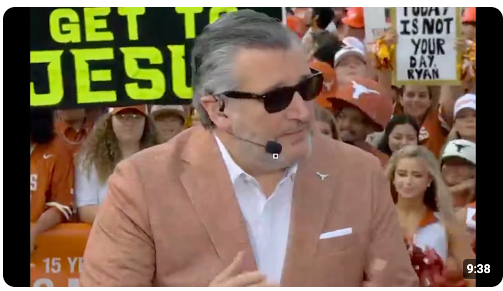
I was at the gym Saturday morning, as I usually am, and among the many TVs playing harmless background shows, I saw Ted Cruz's face. I thought this was odd, since my gym almost exclusively shows sports channels, but it's political ad season and I assumed this was part of a campaign ad. Nope, it was ESPN's flagship College sports show, College Gameday, and Ted Cruz was being interviewed in a one on one set, about the state of college sports. Ew.
If you're wondering what all the fuss is about, ESPN has not posted it's interview with Cruz on it's official YouTube or social media accounts. Thankfully, this is 2026 and everything put on air is archived somewhere, so let's see how long this video stays up before ESPN files a copyright claim.
If you, like many in the crowd, cannot stand Ted Cruz and do not want to listen to the zodiac killer, the summation is that Cruz is the co-author of the Protect College Sports Act, a bill that I wrote about a few weeks ago as being "effectively dead."
I could probably write 1000 words on the Protect College Sports Act itself, but the easiest way to describe the bill is as a hasty attempt to score political points for politicians before a contentious election cycle and the NCAA to reign in the chaos they have failed to control as numerous legal challenges show that their current operating model is mostly illegal. An anti-trust exemption would be established for the NCAA with protections for conferences to limit realignment and any breakaway super leagues, cap spending on rosters to ensure more parity across the sport in terms of roster compensation, and limit player movement via transfers.
As you can imagine, there is a lot of surface level support for preserving the good of college sports. However, anyone who has spent time with this bill sees the very obvious labor rights violations attempted to be encoded into law, and the hypocrisy of limiting player movement, but not coach movement, which can often cost much more than player transfers. As such, there is bipartisan opposition to this act, which is why it has failed to even get out of Cruz's Senate.
Cruz, and many others including the Big 10 and SEC, are pushing for a Hail Mary of sorts appealing to the current President's vanity and love of spectacle to try a late lobbying push of enough Republicans to get this bill passed before election season. Among those "many others" is ESPN and other rights holders like Paramount, and not just by giving airtime to defenders of the bill; Open Secrets dug through disclosures to find that Disney, the parent company of ESPN, has been funding lobbying groups that support that bill.
This makes a ton of sense: ESPN is among the largest (and therefore most financially invested party) in college sports television rights, specifically football. The current unregulated state of football makes these long term rights deals far less stable, and as the NFL continues to be a loss leader for rights holders, ESPN is attempting to use College Football as a way to balance the books. You can't bank on that balance if the current playoff format ESPN is so heavily invested in changes every other year, or may be rendered obsolete by a super league that breaks away from the current conference setup.
ESPN putting it's finger on the scale in such a way is big step for a network that has tried to very much toe the line between being "political" and "being politically aware." It's very clear leadership sees College Gameday as a platform with a high level of reach and the ability to set the tone of conversations across the sport. That can be true, but a media organization absolute must ask itself if it should use that kind of platform to campaign for agendas that are very financially motivated by potential political legislation.
And it's not like ESPN has not been trending this way for awhile. Nick Saban has been a very vocal supporter of this bill or any government intervention, going so far as to meet with President Trump earlier this year. Pat McAfee has had plenty of both political and non-political scandals, and yet was given more money and has become the heir to the Lee Corso type of content on the show. Neither of these have been met with much support.
Look: I'm not the only one taking a look back at what happened this weekend and having conflicting thoughts. Awful Announcing is asking a lot of the same questions I am and Bomani Jones effectively dissects and criticizes ESPN for what appears to be a flagrant divergence from it's usual "stick to sports" memorandum.
I think part of the frustration across the board is that College Gameday used to be the rare show that was both for insiders and the general public. ESPN's ability to show up to a college campus and rig up a three hour pre-game show for the entirety of a sport was both a novelty and an achievement. But over the last few years, as FOX's Big Noon has become a viable competitor and social media influencers and media personalities can create their own on demand preview shows for a fraction of the cost, College Gameday has had to evolve.
The evolution they have moved towards is one that makes sense for a media company heavily invested in the sport itself: loud voices, saying things that benefit ESPN's wallet loudly, and being more of a spectacle than a performance. It clearly is resonating with an audience that ESPN feels is worth chasing and curating towards. I just don't think it's an audience that has much loyalty, and in it's shift, ESPN is pushing away the College Gameday loyals who helped build the show's reputation.
If ESPN feels that they get more bang for their buck using Gameday to shill their political agenda, their rightsholders' agendas, and make a bunch of TikToks on location, that's absolutely their right. But it's not what College Gameday was built to be, and it's certainly not how Reece Davis, Desmond Howard, Nick Saban, or even Pat McAfee would describe the show*. That disconnect is alienating viewers slowly, and putting someone like Ted Cruz on screen for ten minutes is just going to hasten that disconnection moving forward.
*Kirk Herbstreit might, if only because Peter's emergence as a social media darling has 100% impacted how the show navigates space, but who doesn't love a dog?